
Wellcome supermarket in Hong Kong
Who owns Wellcome, and how the chain fits Hong Kong retail
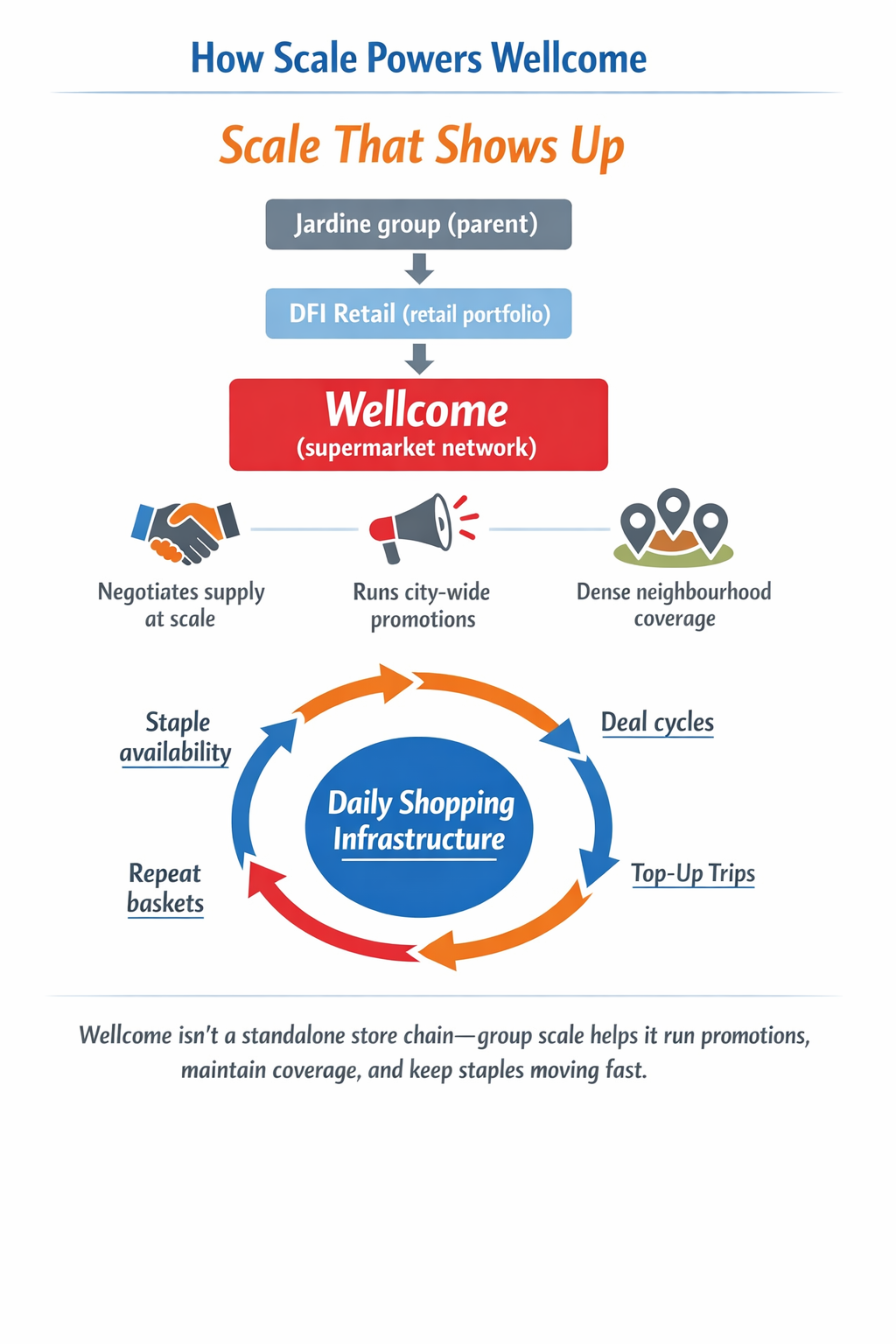
Wellcome is owned by DFI Retail Group, the grocery arm inside the wider Jardine Matheson group. In practical terms, that matters because Wellcome is not a standalone supermarket making isolated decisions. It sits inside a retail portfolio that also includes convenience and health-and-beauty brands, which means it can negotiate supply at scale, run city-wide promotions, and keep a dense store network that works like “daily shopping infrastructure” for many neighbourhoods.
In Hong Kong retail, Wellcome’s role is the mass-market counterweight to premium specialists and smaller independents. It competes on coverage, basket staples, and promotion-led pricing, with formats that range from compact estate stores to larger branches that carry broader fresh and packaged ranges. You can think of it as one of the chains built for repeat weekly shops and top-up trips close to home, predictable selection, and deal cycles that shape how many households plan groceries.
Where Wellcome stores are, and how to choose the right branch for your needs
Wellcome stores are spread across Hong Kong Island, Kowloon, and the New Territories, with a dense network designed for “close-to-home” grocery runs rather than destination shopping. The simplest way to find the nearest branches (and check exact opening hours) is the official store locator, which lists locations by area and includes store-by-store details.
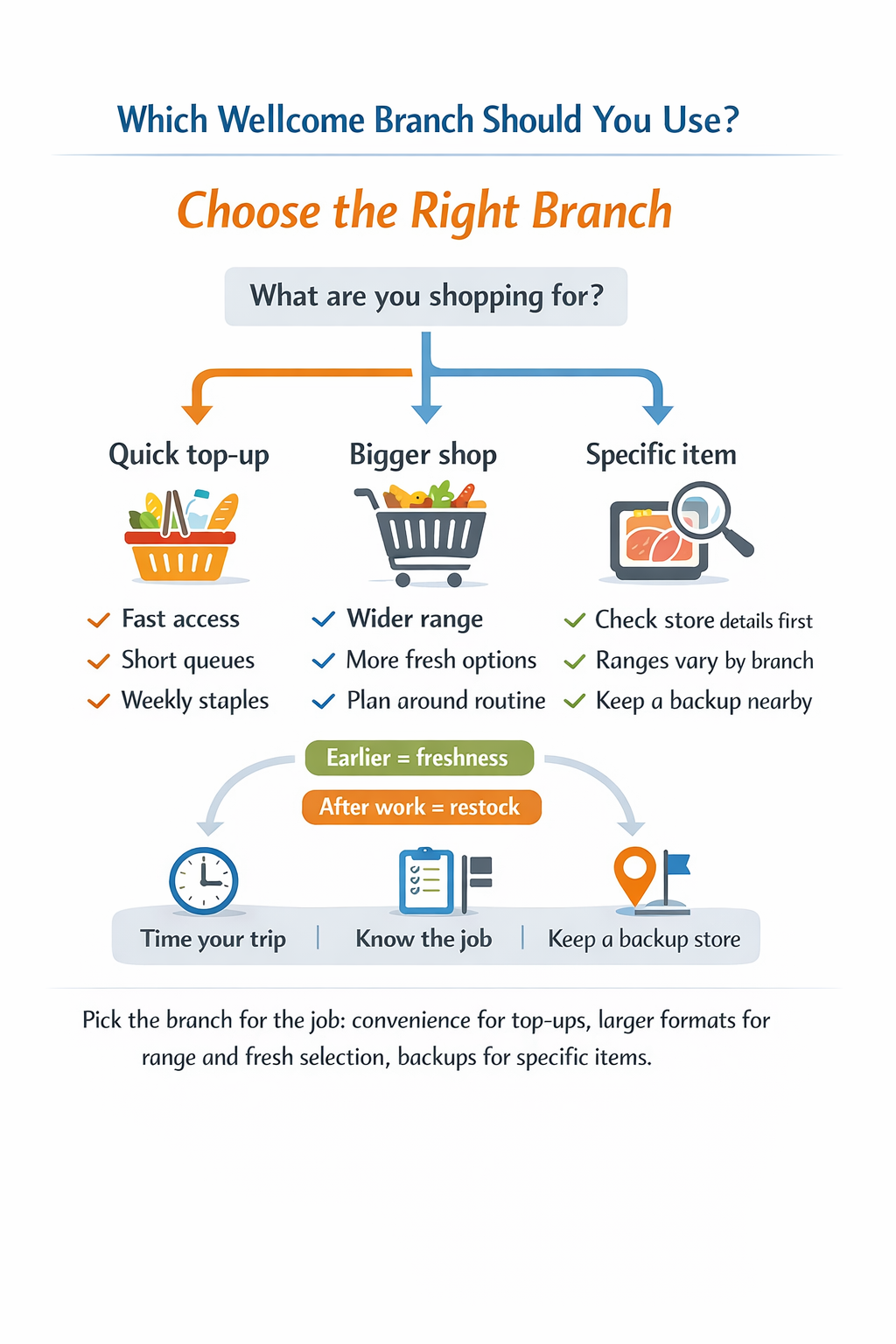
To choose the right branch, start with the job you need it to do. If you’re doing a quick top-up (milk, bread, fruit, last-minute dinner), pick the most convenient neighbourhood store and focus on speed: easy access, shorter queues, and the basic staples you buy every week. If you’re planning a bigger shop, look for a larger branch that typically carries a wider range and more fresh options, then time your trip around your routine after work for pantry restocks, or earlier in the day if you care most about freshness and full availability. If you’re shopping for a specific item (an imported brand, a particular cut, a dietary product), check the store details first and keep a backup option nearby, because ranges can vary by branch and local demand.
What Wellcome sells best: fresh, pantry staples, imported lines, and ready-to-eat
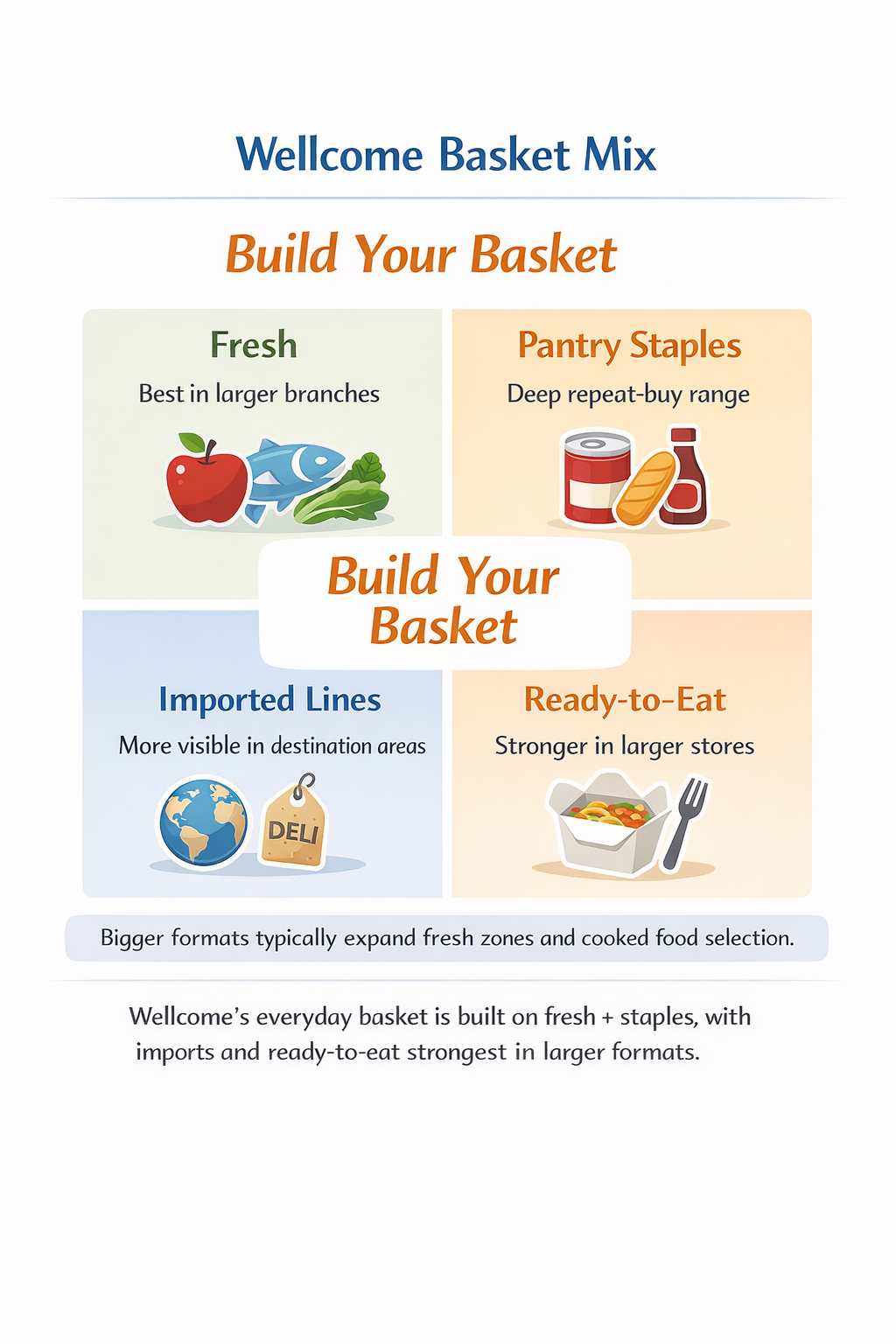
Wellcome’s strongest range is built around everyday baskets. The online store categories show the core mix you’ll see across most branches: fruits and vegetables, meat and seafood, dairy and chilled, bakery, frozen food, snacks, drinks, plus household and personal care.
Where Wellcome stands out is “fresh + convenience” at scale. Fresh produce is a headline category, and bigger formats push it further with wider selections and more service-style counters. DFI’s Wellcome Fresh concept, for example, is positioned around fresh zones (produce, butcher, seafood) and a large in-store cooked food area for quick meals.
If you’re shopping for pantry value, Wellcome’s range is deep in the staples that households repeat every week: canned and preserved goods, condiments and sauces, noodles, snacks, and frozen items (including ready-to-heat options). Those lines also support bulk buying and “case deal” style purchasing, which is common when shoppers want predictable savings without changing brands every week.
Imported lines show up most clearly in “destination” fresh and deli areas. Wellcome Fresh’s own description highlights ingredients sourced from multiple regions (including Japan, Korea, Australia, Europe, and the US) and imported chilled/frozen seafood, which signals how the chain uses imports to upgrade the basket without becoming a pure premium grocer.
For ready-to-eat, think branch-by-branch. Larger stores and the Fresh format lean into grab-and-go, while the online range includes “ready meals & ready to cook” and deli-style cooked meats and seafood. If your local branch is smaller, it may still cover basics well, but you’ll usually get the best cooked selection in bigger locations.
How Wellcome pricing works: promotions, loyalty offers, and weekly deal patterns
Wellcome pricing is usually a mix of a standard shelf price and a promotion price that only applies when you buy in a certain way. Many everyday items are pushed through multi-buy deals like “2 for” or “3 for,” where the unit cost drops only if you hit the required quantity. You can see this clearly on Wellcome’s product listings, where an item shows both the normal price and the multi-buy offer side by side.
Promotions also run in visible weekly cycles. Wellcome publishes a “this week’s ads” page that groups current campaigns into themed sections, which is a quick way to spot where the chain is trying to move volume that week (for example, seasonal bundles or category-led pushes). Treat these weekly ads as your map: they tell you what is discounted now, not what is “always cheap.”
Loyalty adds another layer. Wellcome links heavily to the yuu Rewards Club, where you earn points and can redeem them for cash vouchers or other rewards inside the yuu app. Some yuu offers are not automatic you may need to activate them in-store by scanning a QR code in the yuu app before you get the bonus points, and the bonus is based on the net spend after discounts. On top of that, Wellcome sometimes runs payment-partner promotions (for example, Visa campaigns with set dates and spend rules), which can work like an extra discount if you already use that payment method.
If you want to pay less without overbuying, use a simple routine:
-
Check “this week’s ads” before you go, then plan meals around what’s actually on offer.
-
Compare unit prices on multi-buy deals, especially if you won’t use three or four of the same item.
-
Use bulk “case deal” promos for heavy repeat buys like drinks and pantry basics, where the savings usually justify the volume.
-
Stack carefully: a weekly discount plus a yuu cash voucher can help, but bonus-point offers may require activation and have conditions.
-
Keep card offers as a “nice extra,” not your main plan terms, dates, and eligible spend rules change by campaign.
Online shopping at Wellcome: delivery coverage, substitutions, and click-and-collect basics
Online ordering from Wellcome works well when you treat it like a service that changes by address, not a single “one-size” store. Your delivery area decides what you can buy and whether home delivery is available at all, so the first step is always setting (or switching) your delivery address in your account. You’ll sometimes notice the range shift after you do this, because the site flags that product availability can differ by district.
For delivery coverage, plan around two realities: time slots sell out, and some addresses may be outside the current service area. If the site can’t serve your location, it will block checkout until you choose a different delivery address. When delivery is available, Wellcome promotes a free-delivery threshold (commonly shown as free delivery once your order reaches HK$500), so smaller baskets may carry a fee that you only see once you pick a slot and reach checkout.
Substitutions are the part that catches people off guard. Stock can change between the time you add items and the time the order is picked, especially for fresh and popular promo lines (you’ll see items marked as temporarily out of stock on product pages). The safest approach is to decide in advance what you are happy to swap and what you are not. For brand-specific items (baby formula, dietary products, a key cooking ingredient), add a backup item to your cart yourself so you stay in control if your first choice disappears.
Click-and-collect is the simpler option when you want fewer surprises. Many items show both home delivery and store pickup as available delivery methods, and the online shop often displays free pickup once you meet a small minimum basket value (commonly shown as HK$50 on product pages). You choose a participating pickup point, place the order, then collect using your order details at the counter. Wellcome has also promoted pickup at a large network of designated stores, and partnerships (such as foodpanda) have highlighted wide pickup coverage.
Practical checks that save time on your next order:
-
Set the delivery address first, then build the basket (so you’re shopping the right range for your area).
-
Put fresh items and “must-have” items in early, then book the slot (fresh sells out faster than packaged goods).
-
For anything you won’t accept a swap on, add a backup item yourself (same brand, different size) so you decide the substitute.
-
If you need reliability more than door-to-door convenience, use click-and-collect for a controlled pickup plan.
What to check in-store for better value: freshness cues, expiry dates, and cold-chain handling
Better value in-store is not only about the sticker price. It is also about what stays fresh long enough to use, and what won’t end up in the bin. A cheap pack that spoils early costs more than a slightly better one that lasts.
Start with simple freshness cues. For fruit and veg, pick pieces that feel firm for their type, with even colour and no wet patches at the bottom of the bag. Leafy greens should look crisp, not limp, and herbs should smell clean, not musty. With meat and seafood, look for tight packaging and a clean surface. Excess liquid in the tray, strong odour, or dull colour often means you’re buying shorter shelf life. For bread and bakery, the best value is usually the loaf you can finish; sliced packs that feel damp tend to go stale or mould faster.
Expiry dates are your second filter. Use-by dates are the hard line for safety. Best-before dates are about quality, so you can buy closer to the date if you plan to eat it soon. When you spot a reduced item, do a quick plan in your head: “Am I using this today or tomorrow?” If not, leave it. Discounts only pay off when the food gets eaten.
Cold-chain handling is where value is won or lost, especially for chilled and frozen items. Choose products from cold cabinets that feel cold to the touch. For frozen food, avoid bags with heavy ice crystals, clumped pieces, or soft corners these can signal partial thawing. Build your basket in a smart order so cold items spend less time warming up.
-
Pick chilled, frozen, and ice cream last, right before checkout.
-
Keep an insulated bag ready if you have a longer trip home.
-
Skip damaged packs: torn seals, bulging lids, crushed cartons, or leaking trays.
-
If a deal requires multi-buy, only take the extra units you can store safely and finish on time.