
What are the best platforms to list my business in Hong Kong?
What Are the Best Platforms to List My Business in Hong Kong for Visibility, Trust, and Local Lead Generation?
A business can be excellent and still stay invisible if it is listed in the wrong places. In Hong Kong, that problem shows up fast: buyers compare providers through Google, maps, local directories, social platforms, and sector-specific websites long before they fill in a form or make a call. They may also check whether a company appears properly recorded after it is registered and whether its details align with what is shown through the Companies Registry. A weak listing does not just reduce exposure. It also lowers trust at the exact moment a prospect is deciding who looks credible.
This article explains how to choose the best platforms to list your business in Hong Kong based on visibility, buyer intent, and lead quality. It will help you distinguish between listings that simply create another citation and platforms that can actually support local discovery, reputation, and measurable enquiries.
Why business listing platforms still matter for Hong Kong companies in 2026
Business listing platforms still matter because buyers rarely trust a company after seeing it only once. They usually check more than one source before they make contact. A strong listing helps a business appear active, legitimate, and easy to reach. A weak one creates doubt.
In Hong Kong, that matters even more because competition is tight and customers often make quick comparisons. They look at the business name, contact details, service area, photos, reviews, and how clearly the company explains what it does. If that information is missing or inconsistent, the business can lose the lead before the website visit turns into an enquiry.
Listings also support visibility in a practical way. They help businesses appear where people are already searching, whether the customer wants a nearby service, a specialist in a certain district, or a supplier with a clear track record. A company does not need to be listed everywhere. It needs to be present on the platforms that its real customers are likely to check during the decision process.
For smaller firms, this is one of the simplest ways to compete without depending entirely on paid advertising. For larger firms, listings help control brand presentation across different channels. In both cases, they shape first impressions. That is important because local lead generation often depends on trust formed before the first call or message.
By 2026, business listings are not just digital directory entries. They are part of how a company proves it is credible, reachable, and worth considering. A business that manages them well gives buyers fewer reasons to hesitate.
How to judge a business listing platform by traffic quality, buyer intent, and local search value
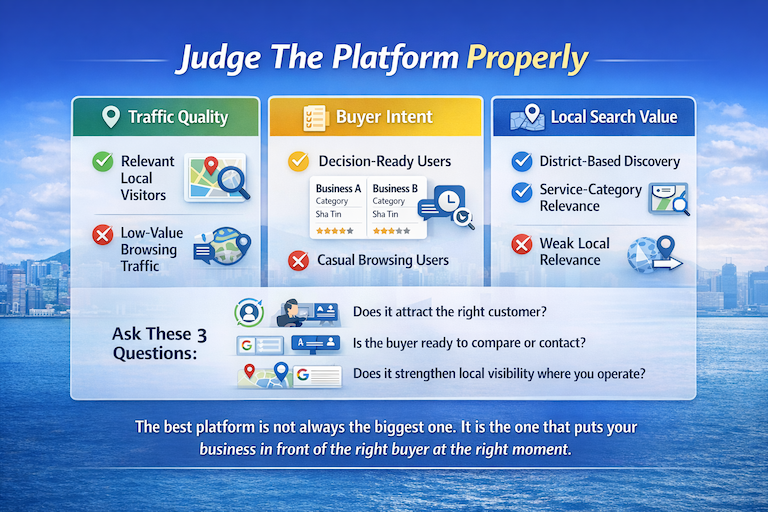
Not every listing platform deserves your time. Some send visitors who are ready to contact a provider. Others produce impressions that look useful on paper but bring little commercial value. The right test is not whether a platform is well known. It is whether it puts your business in front of the right people at the point they are ready to act.
Start with traffic quality. A platform may claim high visit numbers, but that does not mean those visitors are relevant to your business. A Hong Kong accounting firm, for example, gains more from 200 visits by local company owners than from 5,000 low-intent views from users who are only browsing. Good traffic comes from people who match your service area, business category, and likely buyer profile. If a platform attracts the wrong audience, the listing may increase exposure without producing real enquiries.
Next, look at buyer intent. This is where many businesses make poor decisions. A directory used mainly for casual discovery is different from one used by people comparing suppliers, checking credibility, or searching for a service they need soon. Strong buyer-intent platforms usually make it easy for users to take action. They show contact details clearly, support category-based searches, and help visitors compare businesses based on location, service fit, or reputation. If a platform hides important information or distracts users with unrelated content, it is less likely to convert attention into leads.
Local search value matters just as much. A good listing platform should strengthen your presence in the areas where you actually do business. For a company targeting Hong Kong customers, that means the platform should help users find businesses by district, service type, or nearby relevance. A contractor serving the New Territories does not benefit much from a listing that brings mostly overseas views. A better platform would help local buyers discover that firm when they are looking for help in the right part of the market.
It is also important to judge how well the platform supports business trust. A listing has more value when it allows a company to present complete and accurate information. That includes company name, phone number, address, opening hours, service description, photos, and clear category placement. Buyers often compare several businesses in minutes. If your listing looks thin, outdated, or hard to verify, the platform may still deliver traffic, but that traffic will not convert well.
One practical way to assess a platform is to ask three simple questions. Does it attract the kind of customer you want? Does that customer appear ready to compare or contact a provider? Does the platform strengthen your visibility in the Hong Kong areas and categories that matter to your business? If the answer to any of these is no, the listing may add noise rather than value.
The best platforms are rarely the ones that promise the widest reach. They are the ones that bring relevant visitors, support decision-making, and increase your chances of being chosen by a local buyer. That is the standard that matters.
Which types of Hong Kong business directories work best for local services, retail, and B2B firms
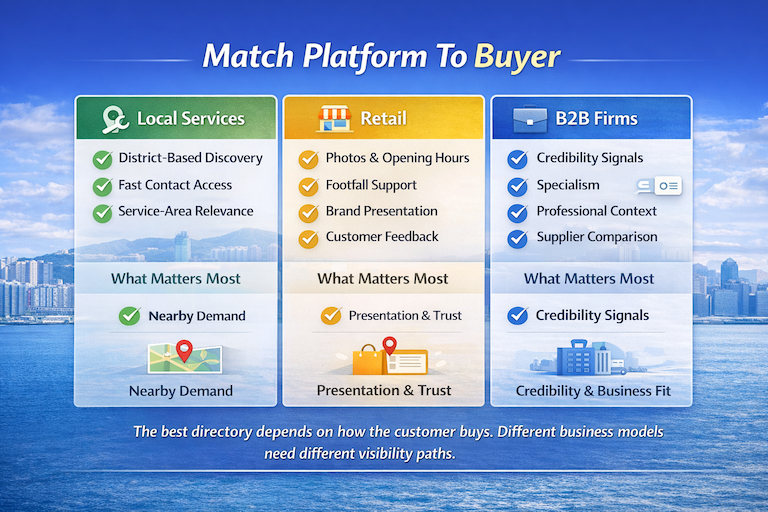
The best directory depends on how the customer buys. A local plumber, a fashion shop, and a wholesale supplier do not win business through the same path. That is why many companies waste time listing themselves everywhere instead of focusing on the platforms that match their sales model.
For local service businesses, the strongest directories are usually the ones built around location and immediate need. These work well for trades, clinics, tutors, repair companies, agencies, and other firms that depend on nearby demand. A customer looking for help often wants three things fast: proof the business is real, confirmation it serves the right area, and a simple way to make contact. In that case, directories that organise businesses by district, service category, and contact details tend to perform better than broad platforms with weak local filters.
Retail businesses need a different type of visibility. A shop, restaurant, salon, or consumer brand usually benefits from platforms that support discovery as well as decision-making. The listing should help people understand what the business sells, where it is located, when it is open, and why it is worth visiting. Visual presentation matters more here. Photos, product highlights, store details, and customer feedback often shape whether someone visits in person or clicks through to buy. For retail, a directory works best when it supports both footfall and brand trust, not just a name-and-phone-number entry.
B2B firms should be more selective. A business selling company formation, logistics, compliance, software, commercial interiors, or sourcing services usually does not need mass consumer exposure. It needs to appear in places where decision-makers compare providers by credibility, specialism, and business fit. That makes industry directories, professional networks, trade association listings, and commercial marketplaces more useful than general local directories. A finance director or operations manager is less interested in flashy presentation and more focused on whether the supplier looks established, relevant, and capable of handling the work.
There is also a middle group that many Hong Kong companies fall into. Some businesses serve both local consumers and other companies. A printing company, event supplier, marketing agency, or IT support firm may need visibility across more than one type of platform. In those cases, the best approach is not to treat every directory equally. Use broad local listings to support discovery, then strengthen trust through niche or sector-specific platforms where buyers compare specialist providers.
The key is to match the directory type to the buying behaviour. Local services need area-based discovery. Retail needs visibility plus presentation. B2B needs credibility in the right professional context. Once a business understands that distinction, directory selection becomes a commercial decision rather than an admin exercise.
Why Google Business Profile should be treated as the first listing every Hong Kong business claims
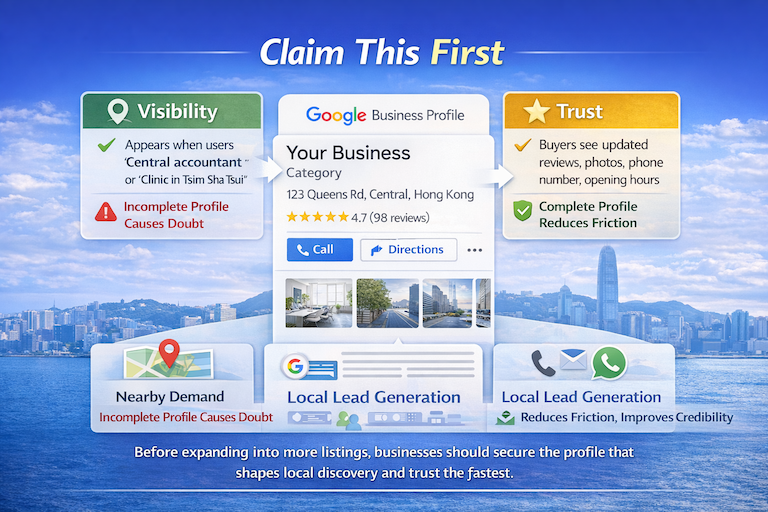
For most Hong Kong businesses, Google Business Profile should be the first listing claimed because it influences visibility, trust, and local lead generation at the same time. When a potential customer searches for a service, compares providers in a district, or checks whether a company looks real, this profile often shapes the first impression before the website visit even begins. If the profile is missing, incomplete, or outdated, the business creates doubt at the exact point where the buyer is deciding who feels credible enough to contact.
This matters because local intent is usually direct. A customer searching for an accountant in Central, a clinic in Tsim Sha Tsui, or a repair company in Kowloon is not looking for general brand awareness. They want clear details fast: what the business does, where it is, when it is open, and how to get in touch. A well-managed profile answers those questions in one place. That reduces friction and makes it easier for the business to win the click, call, or visit.
It also works as a trust filter. Buyers often compare several providers in minutes, and they notice weak signals immediately. Missing hours, poor category choices, old photos, inconsistent phone numbers, or thin descriptions make a company look neglected. A complete profile does the opposite. It signals that the business is active, reachable, and serious about how it presents itself.
For smaller firms, this is one of the few listings that can support local discovery without heavy spending. For established companies, it is still a control point that protects brand accuracy and supports enquiries from high-intent searchers. That is why it should come first. Before a business expands into niche directories, sector platforms, or wider citation work, it needs to secure the listing most likely to affect how local buyers find and judge it.
The practical lesson is simple: treat Google Business Profile as core business infrastructure, not a minor marketing task. In Hong Kong, where competition is tight and buyers compare quickly, the first claimed listing should be the one that helps customers verify, trust, and contact the business with the least hesitation.
When local Hong Kong directories add value beyond Google and social media
Google and social media are important, but they do not answer every buyer need. Search results can be broad, and social platforms often reward attention more than accuracy. Local Hong Kong directories become useful when a buyer wants a faster way to compare providers by area, service type, or business category. In that moment, a directory can do something more practical than a general search or a social post.
They are especially valuable when trust depends on context. A company may look credible on its own website, but a structured presence in a relevant local directory can reinforce that credibility. It shows the business in a setting where buyers expect to compare real providers, not just read promotional content. That matters for firms in professional services, home services, education, healthcare, retail, and other categories where people often review several options before making contact.
Local directories also help when a business serves a specific district or a narrow part of the market. A social media page may attract broad attention, but a directory can place the company in front of users who are already filtering by location or need. That usually creates stronger commercial value than general visibility alone, because the user is closer to taking action.
They also add value when they improve consistency. Buyers lose confidence when a company’s name, phone number, address, or service scope looks different across platforms. A strong presence in trusted local listings helps reduce that confusion and supports a more stable first impression. For newer businesses, that can make the company look established sooner. For older firms, it helps protect credibility.
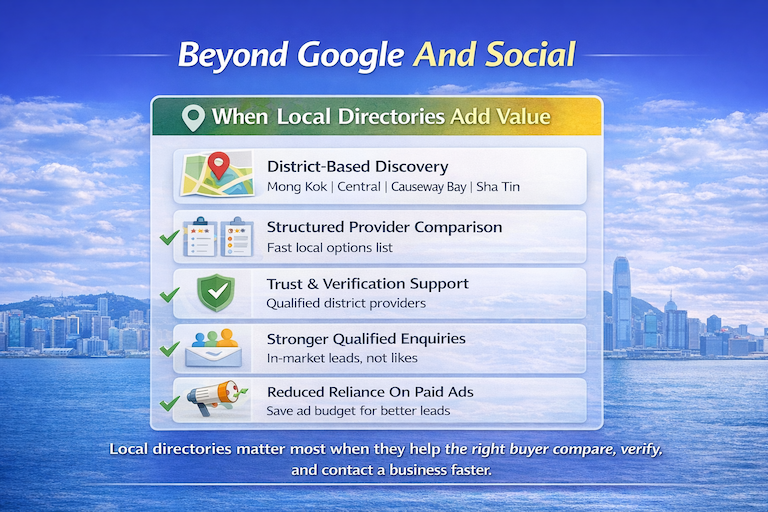
Local Hong Kong directories tend to matter most in a few clear situations:
- A business depends on district-based discovery, such as customers searching within Central, Mong Kok, Causeway Bay, or Sha Tin.
- The buyer is comparing several providers at once and wants a structured list rather than mixed search results.
- The company operates in a category where trust and verification matter before first contact.
- Social platforms bring attention, but not enough qualified enquiries.
- The business wants to strengthen local presence without relying only on paid ads.
The key point is simple: local directories add value when they support decision-making, not just exposure. If a listing helps the right buyer find, compare, and trust the business faster, it is doing work that Google and social media do not always handle well on their own.