
International Schools in Hong Kong 2025–26: Fees, Curricula & How to Get a Place
A Practical Guide to Fees, Curricula, and Getting a Place
Updated March 2026 · shareit.hk
Hong Kong has around 53 officially registered international curriculum schools a number that sounds reassuring until you realise they differ enormously in curriculum, culture, cost, and how long you’ll wait for a place. A family arriving from London faces very different choices than one relocating from New York or Singapore.
This guide covers every registered school grouped by curriculum, a plain-English breakdown of what fees actually include, how the admissions process works in practice, and how to decide which school genuinely fits your child not just which one has the best reputation.
All Registered Hong Kong International Schools in Hong Kong by Curriculum
The Education Bureau maintains a register of approved international curriculum schools. The list below reflects the full current register, grouped by the curriculum each school primarily follows.
British Curriculum (IGCSE / A-Level)
- Kellett School 7 Lam Hing St, Kowloon Bay, Hong Kong
- German Swiss International School (English Stream) The Peak & Pok Fu Lam
- Discovery Bay International School Lantau Island
- Lantau International School Lantau Island
- Sear Rogers International School Yuen Long
- Harrow International School Hong Kong Tuen Mun
- Shrewsbury International School Hong Kong Sai Kung
- Korean International School (International Section) Ho Man Tin
- Kiangsu and Chekiang Primary School Braemar Hill
- Kiangsu-Chekiang College, International Section North Point
American Curriculum (AP / Common Core)
- Hong Kong International School (HKIS) Tai Tam & Repulse Bay
- American International School Hong Kong (AIS) Kowloon Tong
- American School Hong Kong (ASHK) Tai Po
- Stamford American School Hong Kong Ho Man Tin
- The Harbour School Ap Lei Chau
- Concordia International School Kowloon Tong
- International Christian School Sha Tin
International Baccalaureate (IB PYP / MYP / DP)
- Chinese International School (CIS) Braemar Hill
- Independent Schools Foundation Academy (ISF) Pok Fu Lam
- Hong Kong Academy (HKA) Sai Kung
- International College HK (ICHK) Sha Tau Kok
- Nord Anglia International School Hong Kong Lam Tin & Kwun Tong
- Victoria Shanghai Academy (VSA) Aberdeen
- Malvern College Hong Kong Pak Shek Kok
- Li Po Chun United World College Sha Tin
- Renaissance College (RCHK) Ma On Shan
- Kingston International School Kowloon Tong
- Think International School Kowloon Tong
- Carmel School Hong Kong Shau Kei Wan & Central
English Schools Foundation (ESF) Network
ESF operates the largest network of English-medium international schools in Hong Kong, covering both British and IB frameworks across 22 schools. Its primary schools all follow IB PYP; secondaries offer IB Diploma and IGCSE.
- Glenealy School Central/Western PrimaryIB PYP
- Peak School The Peak Primary IB PYP
- Quarry Bay School Eastern Primary IB PYP
- Bradbury School Tai Hang Primary IB PYP
- Kennedy School Pok Fu Lam Primary IB PYP
- Kowloon Junior School Ho Man Tin Primary IB PYP
- Beacon Hill School Kowloon Tong Primary IB PYP
- Sha Tin Junior School Sha Tin Primary IB PYP
- Clearwater Bay School Sai Kung Primary IB PYP
- Island School Mid-Levels Secondary IB
- King George V School (KGV) Ho Man Tin Secondary IB/IGCSE
- South Island School Aberdeen Secondary IB/IGCSE
- West Island School Pok Fu Lam Secondary IB/IGCSE
- Sha Tin College Sha Tin Secondary IB/IGCSE
- Discovery College Lantau Island Through-train IB
Canadian Curriculum
- Canadian International School of Hong Kong (CDNIS) Aberdeen Ontario + IB
- DSC International School Braemar Hill Ontario
- Christian Alliance P.C. Lau Memorial International School Kowloon Tong Alberta
- Christian Alliance International School Sha Tin Alberta + AP + IB
Other / National Curricula
- French International School of Hong Kong (FIS) Happy Valley, Jardine’s Lookout, Chai Wan,
Tseung Kwan O - German Swiss International School (German Stream) The Peak & Pok Fu Lam
- Australian International School Hong Kong (AISHK) Kowloon Tong Australian + IB
- Singapore International School of Hong Kong (SISHK) Nam Long Shan
- Japanese International School (JIS) Tai Po IB PYP
- Hong Kong Japanese School (HKJS) Causeway Bay Japanese curriculum
- Korean International School Ho Man Tin Korean + International
- Norwegian International School Tai Po
- Yew Chung International School (YCIS) Multiple Kowloon campuses British-based
- International Montessori School (IMS) Multiple campuses
- Dalton School Hong Kong Tai Hang Dalton Plan
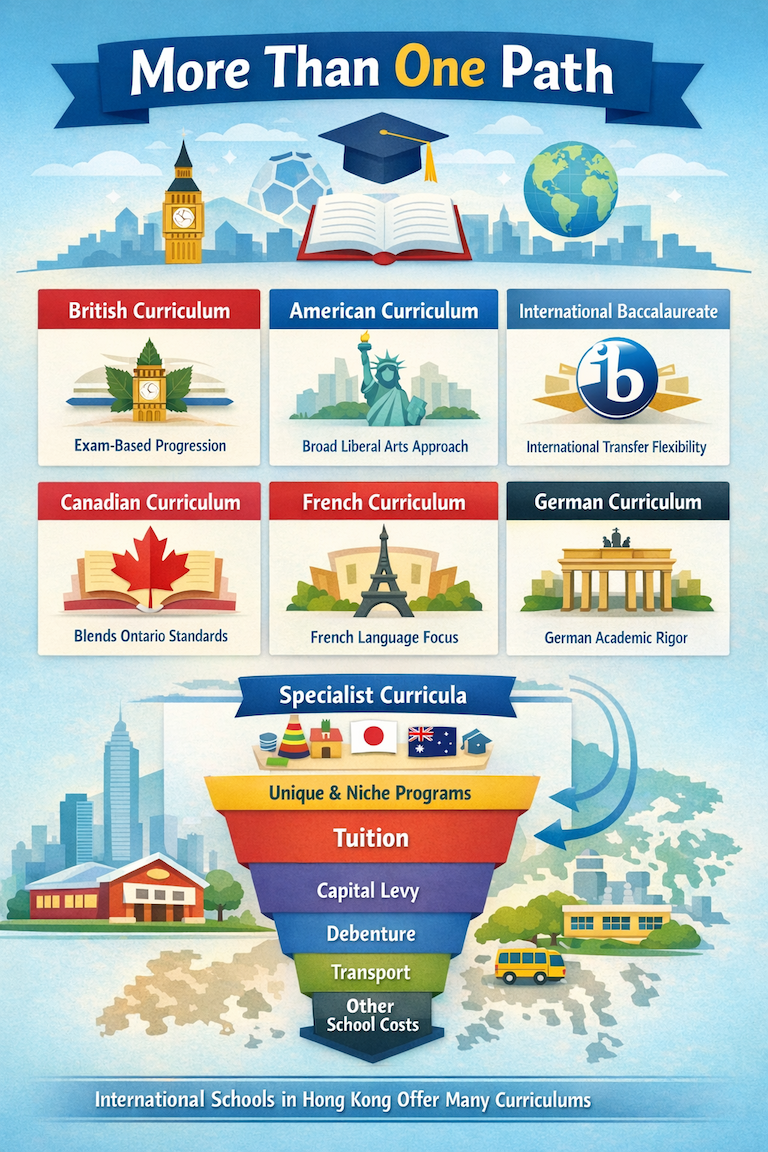
Curriculum Comparison: British vs American vs IB
If your child has already spent time in a particular system, continuity matters. Switching mid-education is possible but can cause real gaps especially in mathematics, where sequencing differs considerably.
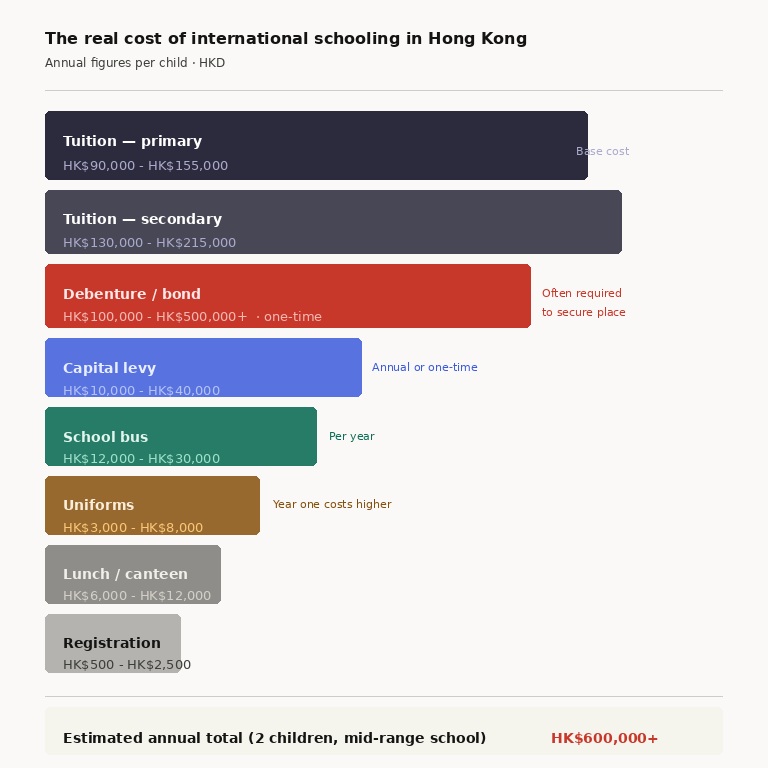
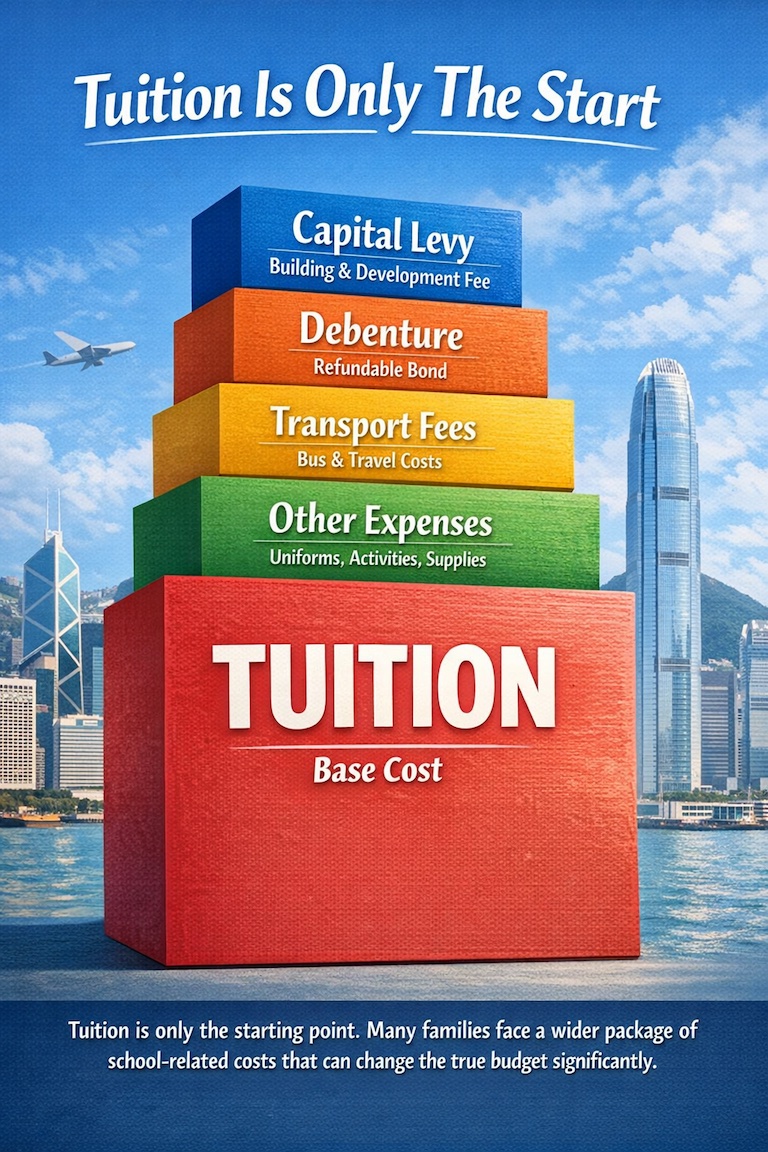
What International Schools Actually Cost in Hong Kong
International school fees in Hong Kong are among the highest in the world. But tuition is only the starting point. Families consistently underestimate the total commitment because several costs are charged separately or aren’t mentioned prominently during admissions.
Where Hong Kong’s International Schools Are Located
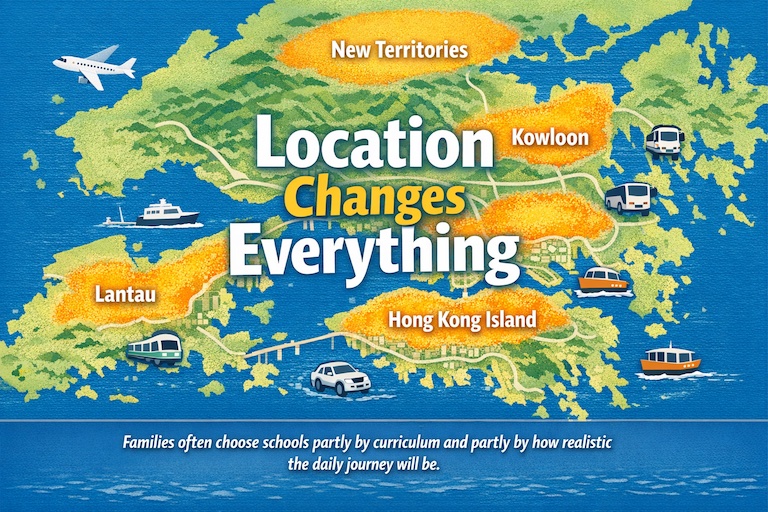
Most international schools cluster on Hong Kong Island, particularly in the southern districts (Repulse Bay, Tai Tam, Aberdeen), Mid-Levels, and the eastern corridor around Braemar Hill. Kowloon has a solid spread, especially around Kowloon Tong and Ho Man Tin.
The New Territories Sha Tin, Tai Po, Ma On Shan are less saturated but have several quality schools, often with larger campuses and lower fees. Families living on the south side of Hong Kong Island tend to have the most options within easy reach.
School buses operate widely but routes can involve 45–60 minute journeys each way. Factor commute time into your decision, particularly for young children.
How Admissions and Waiting Lists Actually Work
For popular schools particularly ESF secondaries, HKIS, Kellett, and CIS waiting lists for some year groups run two to four years. Places in the middle years (Year 5 to Year 9) are consistently the hardest to come by. Applying to three to five schools simultaneously is common and sensible.
Which Curriculum Is Right for My Child?
Curriculum continuity is the most practical starting point. A child who has spent three years in a British system school will find the transition to a British curriculum school in Hong Kong far simpler than switching to an American one. The IB Diploma, if the family’s next destination is uncertain, offers the most flexible global university recognition.
Beyond continuity, consider:
- Language support: Does the school have a structured EAL (English as an Additional Language) programme?
- Class size: Ranges from around 18 to 28 students depending on the school.
- Ethos and culture: Some schools have strong religious affiliations (HKIS is Lutheran; others are Christian-run). Others are explicitly secular.
- Extracurricular provision: Sports facilities, music, and arts programmes vary considerably at secondary level.
Questions to Ask on a School Visit
These are the questions that reveal more than a prospectus does:
- What is your staff turnover rate, and how do you handle teacher changes mid-year?
- How do you support children joining mid-year or mid-cycle?
- What is your EAL provision, and how long does support typically last?
- How are learning differences (dyslexia, ADHD, giftedness) identified and accommodated?
- What is the typical class size at my child’s year group?
- Where do most Year 13 students go to university, and in which countries?
- What is your pastoral care structure? Who is my first point of contact if there’s a problem?
- How do you communicate with parents app, newsletter, direct calls?
- What are the transport options, and how long is the typical journey from my area?
- Are debentures transferable if we leave Hong Kong before the end of the term?
A Few Schools Worth Knowing About
English Schools Foundation (ESF): The largest network of English-medium schools in Hong Kong 22 schools, no debenture required, government-subsidised fees. Demand for places is high across most schools.
Hong Kong International School (HKIS): American curriculum, strong academic reputation, large campus in Tai Tam. Ties to the Lutheran church but open to all. One of the more difficult schools to secure a place at.
Kellett School: British curriculum, two campuses, deliberately smaller and community-oriented. Strong pastoral care and consistent IGCSE results. Well-suited to families who want a less corporate school environment.
Nord Anglia International School: IB framework, part of a global group with partnerships including MIT and Juilliard. Known for specialist arts and STEM provision. Two campuses in Lam Tin and Kwun Tong.
Chinese International School (CIS): One of the few schools with a genuinely bilingual English/Mandarin academic model built into its structure, not just offered as an add-on. Popular with families wanting academic fluency in both languages.
Frequently Asked Questions
How far in advance should I register for an international school in Hong Kong?
For the most competitive schools particularly ESF secondaries, HKIS, Kellett, and CIS registering two to three years ahead is advisable. For schools with more availability, 12–18 months lead time is generally sufficient. Always register at multiple schools simultaneously.
Can Hong Kong permanent residents attend international schools?
Yes. International schools are not restricted to expats or foreign passport holders. Hong Kong permanent residents and local families can and do apply. Most registered international schools enrol a mix of nationalities.
Are debentures refundable when you leave Hong Kong?
It depends on the school. Some debentures are fully refundable on departure; others are partially refundable or only transferable. A small number are non-refundable. Always clarify the specific terms before paying the amounts involved can be substantial.
Which international schools in Hong Kong offer the IB Diploma?
A large number offer IB Diploma, including ESF schools, CIS, ISF, HKA, Nord Anglia, VSA, Malvern, Li Po Chun United World College, CDNIS, and AISHK, among others. Several also offer IB Primary Years (PYP) and Middle Years (MYP).
What is the difference between ESF schools and other international schools?
ESF operates as a non-profit under its own ordinance. Its fees are lower than most private international schools and there is no debenture requirement. However, demand for places is high and it does not guarantee places to siblings or any particular group.
Is financial assistance available for international school fees?
A small number of schools offer bursaries or need-based assistance. ESF offers a limited grant scheme. In practice, most families relying on fee assistance are those whose employers provide an education allowance as part of a relocation package.
How to Approach Your School Search
The families who navigate Hong Kong’s school admissions process most smoothly tend to share a few habits: they register early (before arriving in the city if possible), apply to a realistic spread of schools rather than betting on their first choice, and visit schools in person not just at open days, but by requesting a regular-day visit to see the school when it’s actually running.
The best school for your child is not necessarily the one with the strongest overall reputation. It’s the one where the curriculum continues their academic journey without major gaps, where the culture fits your family’s values, and where the commute doesn’t consume an hour of every day. Those three things narrow the field considerably and make the final decision much clearer.