
Hong Kong: AI & Innovation Hub; Mainland's Artificial Intelligence Centre
Hong Kong: World-Class AI Hub: Supercomputing, Robotics and the Power of Artificial Intelligence at Mainland China's Centre of Innovation
Flush with fresh government capital and a bold industrial strategy, Hong Kong is staking its economic future on artificial intelligence. The opportunity is real but so are the obstacles.
For a city long defined by its port and its trading floors, Hong Kong is attempting a reinvention of historic proportions. In a budget unveiled just days ago, Financial Secretary Paul Chan Mo-po staked the city's fiscal revival not on financial services the old engine but on AI technologies, advanced manufacturing, and deep-tech research. Driven by a sweeping vision for Hong Kong science and technology parks, the message to the markets was deliberate and unmistakable: Hong Kong intends to compete for the title of Asia's innovation capital, with AI development at the very core of its strategy.
The question investors and business leaders are now asking is whether this ambition can be converted into durable economic returns or whether it will become another well-funded aspiration that falls short of execution. Since 2025, the government has moved decisively to foster cutting-edge AI ecosystems across the city, laying the groundwork for Hong Kong to emerge as a truly global hub for technology and innovation.
"Hong Kong wants to be a global hub for technology in the region. The core message is clear."
The Size of the Bet: The Size of the Bet: How Hong Kong AI Hub is Harnessing the Power of Artificial Intelligence Through Supercomputing, Robotics and a Centre of Innovation
The headline figure from the 2026-27 Budget is significant. Financial Secretary Paul Chan has launched a HK$10 billion Innovation and Technology Industry-Oriented Fund a breakthrough commitment targeting life sciences, AI, and robotics that signals the start of a new AI revolution in Hong Kong's development. This is not a standalone measure. It sits within a broader commitment of approximately HK$20 billion to build a cross-border hub for AI and a new technology zone near the Mainland China border, designed to accelerate the commercialisation of research across industry sectors and align with national development priorities set out under China's 15th Five-Year Plan.
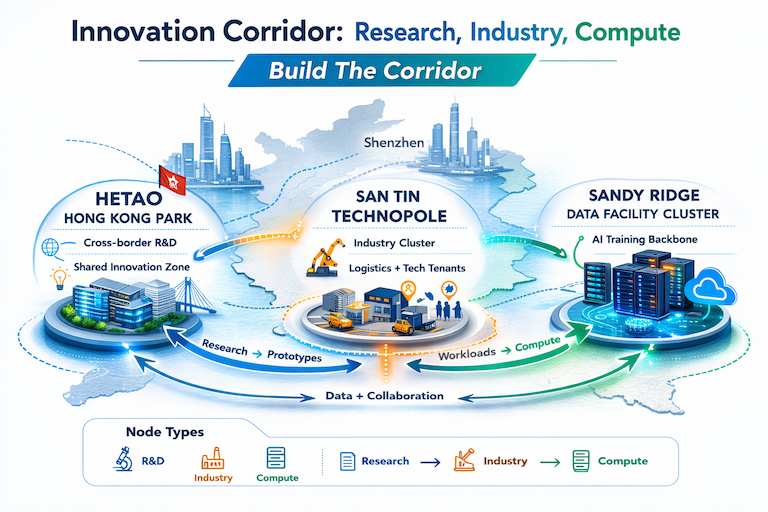
Hong Kong's government departments, the Hong Kong Productivity Council, Cyberport, and the Science and Technology Parks Corporation (HKSTP) are all coordinating to drive innovation across Hong Kong's AI ecosystem nurturing AI companies and building the AI infrastructure needed for Hong Kong to become a global leader. The Sandy Ridge data facility cluster, a landmark investment in supercomputing and computing power, will push Hong Kong's capacity toward tens of thousands of petaflops, providing the backbone for AI training, large language models, and cutting-edge AI applications across industry.
Smart city development, advanced AI integration across government departments, and the rollout of AI-driven services are among the priority areas such as AI that the budget explicitly targets as pillars of Hong Kong's I&T strategy.
Alongside the capital commitments, the government has announced a dedicated AI Research and Development Institute the AIRDI seeded with HK$1 billion and set to launch in the 2026-27 financial year, working alongside InnoHK research institutions and the HKAI Lab to advance the development of AI across Hong Kong's city AI ecosystem. Its mandate spans upstream AI research and development, mid-stream translation of findings into commercial products, and downstream industrialisation covering the full lifecycle from lab to market and enabling AI companies to go global from a leading hub that bridges the Mainland market and international investors.
A new Committee on AI and Industry Development Strategy, chaired by the Financial Secretary himself and comprising experts, academics, and representatives from technology and industry, will guide the development of new AI applications and oversee the integration of AI across industry sectors including fintech, logistics, and life sciences. The committee focuses on areas such as AI in healthcare, generative AI, and embodied AI systems that operate in the physical world through robotics while working to establish Hong Kong as an international innovation and technology hub capable of harnessing the full power of AI.
Hong Kong's AI ecosystem is being structured to nurture new quality productive forces, with development in Hong Kong serving as a model for how an international financial centre can lead the AI industry into a new era. Organisations such as Alibaba, alongside homegrown AI-driven firms supported through Cyberport and the Northern Metropolis development corridor, are expected to anchor Hong Kong's position as the first national manufacturing innovation centre outside the Mainland and as a leading AI hub within the Guangdong-Hong Kong-Macao Greater Bay Area and beyond.
The Infrastructure Push
Capital alone does not build an innovation economy. What Hong Kong is also constructing is the physical and digital backbone to support it. Two large-scale infrastructure projects are central to this strategy: Hetao Hong Kong Park and San Tin Technopole, each conceived as integrated corridors linking research institutions, advanced manufacturing, and commercial enterprises.
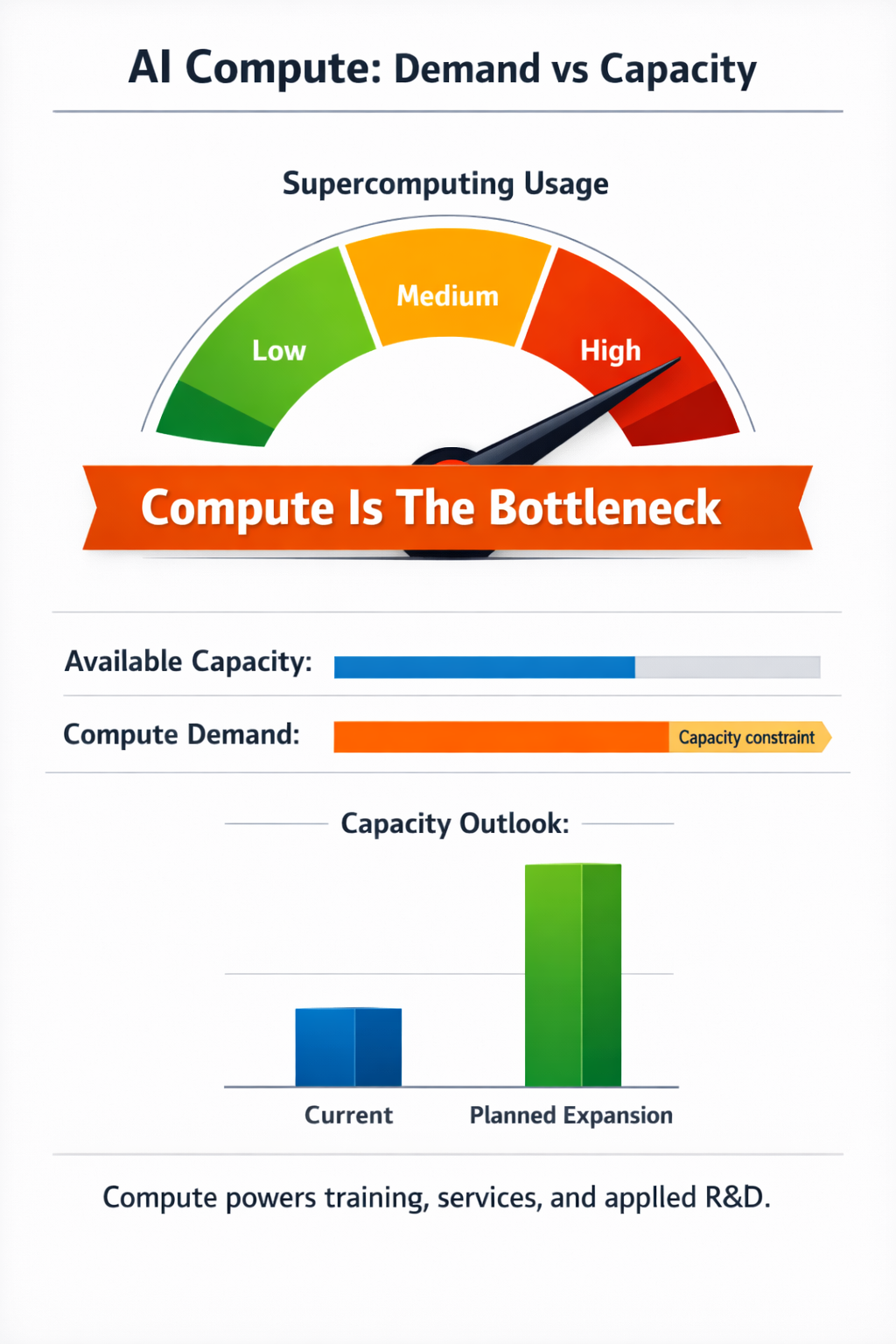
San Tin Technopole, a 540-hectare development, is earmarked to house over 150,000 residents and 160,000 jobs by 2031, with AI-driven logistics firms and tech companies as anchor tenants. A new large-scale data facility cluster at Sandy Ridge is planned to dramatically increase Hong Kong's computing capacity, which already stands at several thousand petaFLOPS. The target is 15,000 petaFLOPS by 2030 a number that matters for the kind of large language model training and AI workloads that modern research demands.
Cyberport, the government-backed tech hub, is already operating its AI Supercomputing Centre at roughly 90% capacity, with around 400 AI-related firms in residence, including operations from iFlyTek and Baidu Apollo. A three-year AI Subsidy Scheme worth HK$3 billion has been launched to allow universities, research institutes, and enterprises to leverage this computing power without having to absorb the full cost of GPU infrastructure themselves.
"The Cyberport AI Supercomputing Centre is already at 90% capacity a demand signal that is difficult to ignore."
Where the Research Is Heading
University laboratories are already producing commercially relevant output. The University of Hong Kong's Department of Electrical and Electronic Engineering has developed a generative AI system capable of real-time 3D scene generation technology with clear applications in interior design, gaming, architecture, and product visualisation. The team is developing a version compatible with mobile phones and desktop computers, with a stated aim of broadening market reach beyond specialist hardware.
The startup ecosystem is producing similarly applied work. Among recent cohorts at Cyberport and the HKTDC's Start-up Express programme, health technology and AI have been consistently dominant themes. Companies are applying machine learning to drug development, neurological disease screening, eye diagnostics, and cell-based immunotherapy. These are not proof-of-concept projects several have reached clinical trial stages or secured commercial partnerships in mainland China and Southeast Asia.
The government has further earmarked HK$500 million for the Chinese Medicine Development Fund, explicitly connecting traditional medicine with AI-driven research and international clinical development. An international clinical trial academy is slated to open next year, with the dual purpose of attracting foreign investment and helping mainland biomedical technology access global markets through Hong Kong's regulatory gateway.
The Greater Bay Area Dimension
No analysis of Hong Kong's tech ambitions is complete without accounting for its relationship with Shenzhen and the broader Guangdong-Hong Kong-Macao Greater Bay Area (GBA). The Hetao Shenzhen-Hong Kong Science and Technology Innovation Co-operation Zone straddling the border between the two cities is designed as a shared innovation platform. Its Hong Kong Park component is central to the government's development roadmap, and cross-boundary data flow has been explicitly addressed through a "Standard Contract" mechanism, extended across all industries to facilitate the safe movement of data within the GBA.
About ten Cyberport enterprises are currently exploring operations in Qianhai, with nearly half focused on AI applications in education technology, e-commerce, and insurance technology. Hong Kong Science Park's Shenzhen branch, which commenced operations in 2023, had admitted 58 enterprises and R&D centres by late 2024, approximately 40 of which were AI-related.
For investors, this cross-border integration represents both an opportunity and a structural feature to understand carefully. Hong Kong's comparative advantage in this ecosystem lies not in low-cost manufacturing or software scale Shenzhen excels at both but in international finance, common law, transparent regulation, and access to global capital markets. The city's role as a "super-connector" for mainland enterprises seeking overseas expansion, and for multinationals entering the Chinese market, remains its most defensible and distinctive position.
Governance and the Regulatory Question
One dimension of Hong Kong's AI strategy that deserves particular attention from the business community is the emerging governance framework. The new AIRDI will have an explicit mandate not just to promote AI adoption but to advise on governance frameworks and regulatory regimes. The government has already published an Ethical AI Framework and Hong Kong Generative AI Technical and Application Guidelines, alongside Principles of Data Governance.
The Hong Kong Monetary Authority has introduced a GenAI sandbox, allowing banks to test AI-driven applications in a risk-managed environment a structure analogous to regulatory sandboxes in fintech that have historically accelerated responsible deployment. For the financial sector, which is expected to be a primary beneficiary of AI integration, this kind of structured experimentation matters. Banks adopting AI for fraud detection, algorithmic trading, and client analytics are likely to see meaningful efficiency gains, and the HKMA's collaborative model with tech firms reduces the adversarial friction that has hampered AI adoption in more cautious jurisdictions.
The Protection of Critical Infrastructures (Computer Systems) Ordinance, which took effect in January 2026, adds another layer: mandatory cybersecurity standards for eight critical sectors, including finance and energy. For multinationals with operations in Hong Kong, this creates compliance obligations but also a clearer, more predictable operating environment than exists in many comparable markets.
The Risks Worth Watching
A balanced assessment requires acknowledging the constraints. Hong Kong's talent pipeline remains a central concern. Years of net emigration particularly among skilled professionals have thinned the local pool of AI researchers and engineers. The government has responded with a Frontier Technology Research Support Scheme worth HK$3 billion, explicitly aimed at attracting international scientific talent. Whether this is sufficient to close the gap against Singapore, which has invested heavily in talent acquisition over the same period, is an open question.
Geographic scale is a structural limitation. Hong Kong is a city-state with finite land, and the competition for real estate between residential development, logistics, financial services, and innovation infrastructure is real. The government's land allocation decisions the 32 hectares reserved in Hung Shui Kiu/Ha Tsuen for a logistics cluster, the land set aside for the Northern Metropolis University Town are consequential, but they take years to translate into usable infrastructure.
There is also the question of market depth. Hong Kong's domestic market is not large enough to sustain an innovation economy on its own. Success depends on export of technology, services, and companies primarily into mainland China and across Southeast Asia. That export depends, in turn, on the continuation of cross-border data and capital flows, on the maintenance of Hong Kong's distinct legal and financial architecture, and on geopolitical stability that cannot be taken as given.
The Investor View
For the business and investment community, the picture that emerges is of a city making a credible and well-resourced bet on a credible thesis, with execution risk that is neither trivial nor insurmountable. The capital commitments are large. The infrastructure is being built. The research is producing commercially relevant output. The governance framework is taking shape in a more investor-friendly direction than many anticipated.
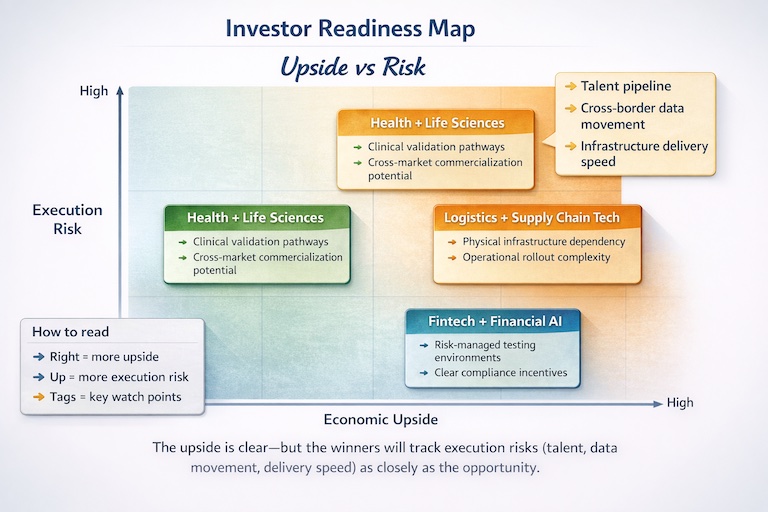
The sectors most likely to reward early positioning are health and life sciences (where the intersection of AI, clinical research, and China market access creates a distinctive proposition), fintech and financial AI (where the HKMA's sandbox and the city's financial infrastructure offer structural advantages), and logistics and supply chain technology (where the Northern Metropolis and San Tin Technopole create a physical base for AI-driven operations).
The watch points are talent, data flows, and the pace at which the large infrastructure projects convert from announced to operational. Hong Kong has a history of building at speed when political will aligns with fiscal resources. Both conditions appear to hold, at least for now.